
Editor's Picks
| # | Name | Best For | Price | Rating | Image | |
|---|---|---|---|---|---|---|
| 1 | MMA academies, boxing gyms, kickboxing studios, and competitive martial arts training centres | Free | 4.8/5 |
|
More Info | |
| 2 | Mixed discipline studios, group fitness and martial arts hybrids, and community-oriented dojos | Free | 4.7/5 |
|
More Info | |
| 3 | Professional martial arts studios, urban dojos, and gyms positioning at the premium end of their local market | Free | 4.7/5 |
|
More Info | |
| 4 | Mindfulness-integrated martial arts studios, traditional dojos, tai chi and qigong centres, and studios blending movement with personal development | Free | 4.6/5 |

|
More Info | |
| 5 | Solo martial arts instructors, private coaches, and individual practitioners building a personal brand around their training style | Free | 4.6/5 |

|
More Info |
Our Picks: The Best Squarespace Martial Arts Website Templates
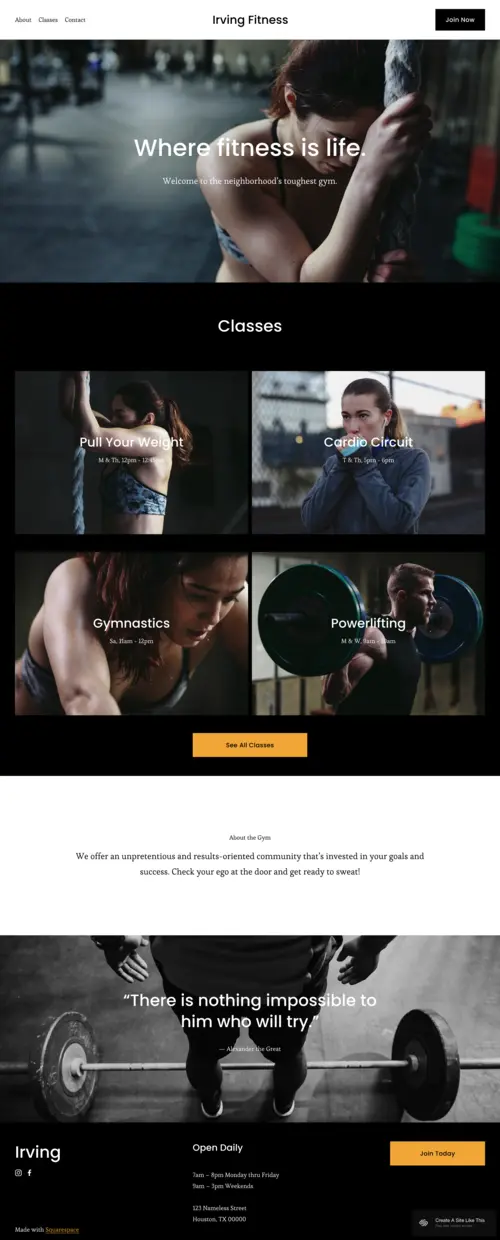
Irving
Best for Competitive MMA Gyms & High-Intensity Martial Arts Studios ✓ Pros
- Full-screen hero image with bold visual impact creates the immediate sense of intensity that competitive martial arts students are specifically looking for - the design communicates "we're serious here" before the first headline is read.
- Dedicated class schedule section architecture makes it straightforward for prospective students to find training times across different disciplines - boxing, grappling, MMA conditioning, and sparring classes can each be listed clearly without the schedule becoming a confusing wall of text.
- Motivational quote placement throughout the layout creates emotional momentum that keeps visitors engaged - and models the culture of the gym in a way that attracts students aligned with your training philosophy.
- Modern, sharp typography conveys the precision and professionalism that serious martial artists expect - a gym that looks sharp online communicates that it runs a sharp operation on the mats.
- Flexible imagery sections support the kind of action photography that showcases training quality - team sparring, competition moments, and coaching interactions tell the story of the gym's culture more powerfully than any written description.
✗ Cons
- The intense, competitive aesthetic is calibrated for serious trainees - studios offering beginner-friendly programs, children's martial arts, or family-focused classes may find Irving's visual energy sets expectations their actual training environment doesn't match.
- High-impact visual design requires professional photography - a gym using low-quality phone shots in Irving's bold layout will find the contrast between design ambition and visual quality undermines rather than builds confidence in prospective students.
- The no-nonsense intensity may not translate well for studios that blend martial arts with mindfulness, meditation, or therapeutic movement practices, where Irving's hard-edged aesthetic sends conflicting signals.
Irving is the martial arts website template that earns respect before you've opened your mouth. The full-screen intensity, the sharp layout, the motivational architecture - it all communicates one thing: this gym is built for people who want to train seriously. For MMA academies, boxing gyms, and any studio where the culture is built on discipline, competition, and results, Irving is the design that attracts exactly the right students and sets the right expectations from the first scroll.
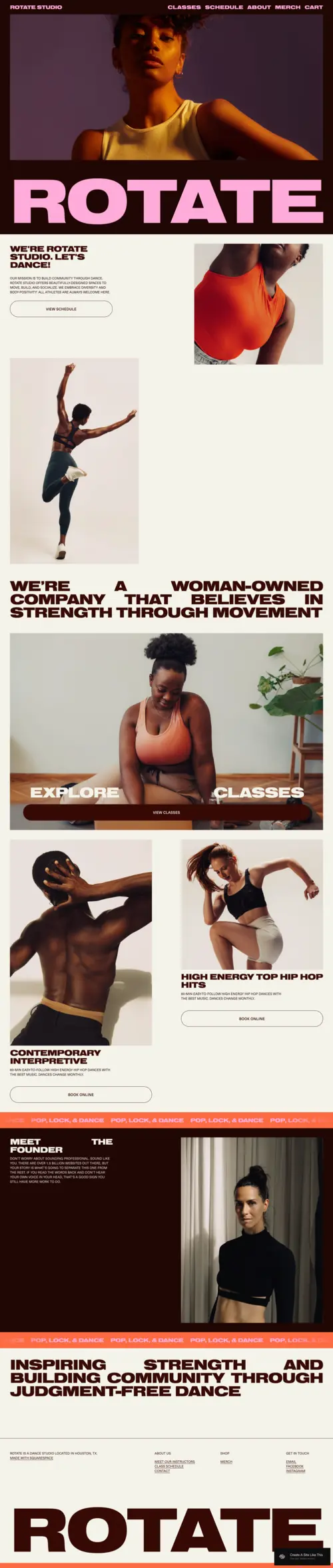
Rotate
Best for Community-Focused Studios & Multi-Discipline Martial Arts Gyms ✓ Pros
- Dynamic, movement-forward layout captures the energy of group training - the design feels alive in a way that static, text-heavy martial arts website templates do not, making it ideal for studios where community and collective energy are central to the experience.
- Class schedule and description sections allow multiple disciplines to be listed side-by-side without competition or confusion - kickboxing, capoeira, jiu-jitsu, and yoga can coexist in Rotate's layout without any single discipline dominating the navigation hierarchy.
- Team bio section architecture makes it easy to showcase a roster of instructors with different specialisations - which builds trust with students who want to know that specialist coaching is available across every discipline the studio offers.
- Bold typographic hierarchy keeps headlines like "Join Our Community" and "Find Your Class" prominent and emotionally resonant - language that speaks to the belonging motivation that drives many martial arts students, not just the performance motivation.
- Energetic aesthetic is versatile enough to communicate both the physical and the communal aspects of martial arts training, giving a multi-discipline studio a single visual identity that doesn't force it to choose one audience over another.
✗ Cons
- The dynamic, multi-section layout requires more content to fill effectively than simpler martial arts website templates - studios with limited class offerings or a small team may find Rotate's architecture creates a sense of empty space that works against them.
- The community-and-movement aesthetic, while versatile, doesn't project the specialist intensity that students seeking elite competitive training specifically look for - a dedicated MMA or BJJ competition team may find Rotate undersells their competitive credentials.
- High visual energy of the template demands strong, varied photography across multiple content sections - a studio without a diverse image library covering different disciplines and training contexts will struggle to fill Rotate's visual architecture convincingly.
Rotate is the martial arts website template for studios that understand their greatest asset isn't their trophies - it's their community. The design is built for places where students train together, push each other, and return week after week because of the people as much as the practice. If your studio offers a range of disciplines and its culture is built on inclusion, energy, and collective progress, Rotate is the template that communicates all of that without requiring a single word of explanation.
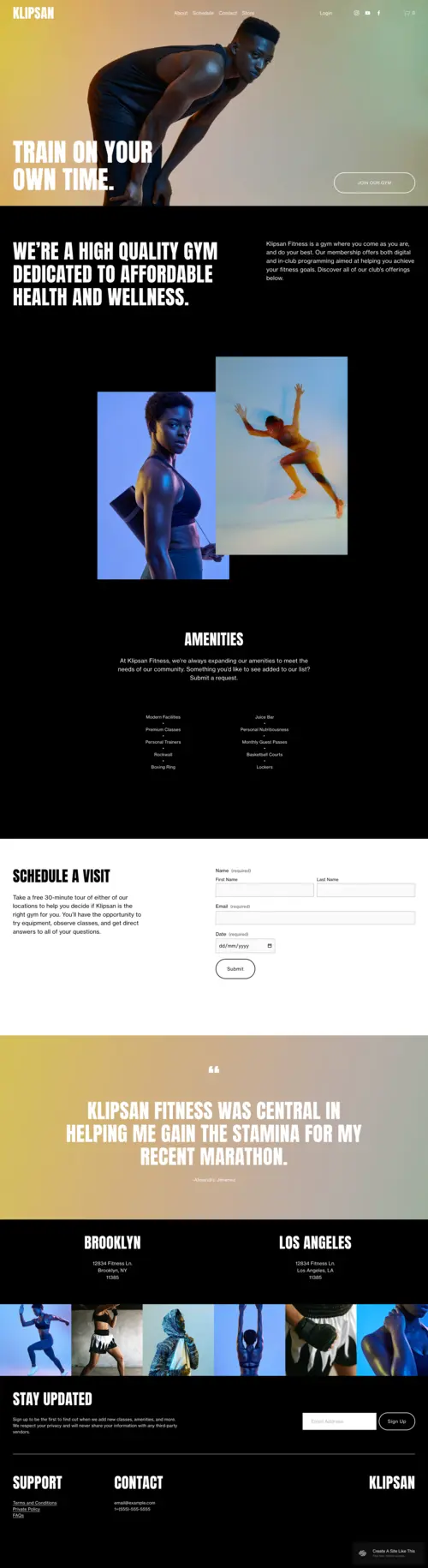
Klipsan
Best for Modern Martial Arts Studios & Gyms Focused on Professional Credibility ✓ Pros
- Sleek design with bold colour gradients creates a modern, premium visual identity that distinguishes the studio from the sea of generic martial arts website templates - in a competitive local market, looking more professional than the alternatives is itself a student acquisition strategy.
- Dedicated amenities section allows the physical facility to be showcased as a selling point - matted floors, changing facilities, weight rooms, and equipment quality are all factors prospective students weigh, and Klipsan gives each element its own visual moment.
- Integrated testimonial architecture builds trust through student voices - which in the martial arts market is particularly powerful, since students join studios based on the experiences of people they identify with, not marketing copy.
- Clear visual hierarchy ensures class schedules, pricing, and contact information are all easy to find without hunting - reducing the navigation friction that causes prospective students to abandon a site before they've committed to a trial class.
- Booking integration sits naturally within the layout - the call to action to schedule a visit or sign up for a class flows from the facility and testimonial sections without feeling disconnected from the rest of the design.
✗ Cons
- The polished, premium aesthetic requires the physical facility to match the design's visual ambition - a studio with modest or utilitarian training space may find Klipsan's sophisticated presentation sets expectations the real-world environment doesn't meet.
- The gradient-heavy design has a more contemporary visual identity than traditional martial arts aesthetics - studios emphasising heritage, lineage, or traditional discipline forms may find the modern aesthetic doesn't align with their cultural positioning.
- Klipsan's architecture is optimised for showcasing a single, focused studio concept - multi-location gym chains or studios with very wide class offerings may find the template's focused layout less scalable than a more expansive design.
Klipsan is the martial arts website template for studios that have invested in both the quality of their instruction and the quality of their training environment - and want a digital presence that reflects both. The premium aesthetic, the facility showcase architecture, the testimonial integration - every element communicates professional credibility. For modern urban martial arts studios positioning themselves at the top end of a competitive local market, Klipsan is the design that wins the comparison on first impression.
Alignflow
Best for Mindful Martial Arts Studios & Dojos Emphasising Discipline and Personal Growth ✓ Pros
- Minimalist layout with generous white space creates an immediate sense of calm and intentionality - the visual language of discipline and focus, which communicates the values of traditional martial arts without a single word of copy.
- Pricing plan section architecture allows a range of membership tiers to be presented clearly and without confusion - beginner, intermediate, and advanced class packages can each be displayed with transparent pricing, reducing the friction that comes from students needing to call to find out what joining costs.
- Instructor bio section is designed to communicate expertise, philosophy, and personal story - essential in martial arts, where students form relationships with their instructors and the lineage and training background of a teacher directly influences a student's decision to join.
- Blog section supports the kind of long-form content that positions a studio as a centre of knowledge - articles on training philosophy, the history of a discipline, injury prevention, and mental discipline build search visibility and deepen community engagement simultaneously.
- Balanced layout communicates both the physical and the philosophical dimensions of martial arts practice - making it suitable for the growing segment of students who come to martial arts as much for mental resilience as for physical skill.
✗ Cons
- The calm, minimalist aesthetic is calibrated for mindfulness-forward and traditional discipline studios - high-intensity competitive gyms and MMA academies will find Alignflow's tone undersells the energy and intensity that attracts their specific student demographic.
- The blog section adds significant value only if the studio has the capacity to publish regularly - an empty or infrequently updated blog on a template that architecturally highlights it signals neglect and works against the professional credibility the design otherwise builds.
- White space-heavy minimalism requires very clean, considered photography - cluttered training environments or low-quality imagery look more exposed against Alignflow's open design than they would in a busier layout.
Alignflow is the martial arts website template for studios that teach martial arts as a path, not just a practice. The design speaks the language of discipline, focus, and patient progress - which resonates deeply with students who come to traditional martial arts or mindfulness-integrated training for the personal development as much as the physical challenge. For dojos, tai chi centres, and studios that blend movement with mental resilience, Alignflow communicates those values immediately, elegantly, and without any visual noise.
Cole
Best for Solo Martial Arts Instructors & Personal Brand-Led Training ✓ Pros
- Full-screen hero image layout immediately centres the instructor as the brand - in solo or personal coaching contexts, the instructor's identity, credibility, and personality are the primary reason a student chooses this training over any alternative.
- Simple, direct navigation guides visitors to the only sections that matter for a solo practitioner: services and class formats, contact and booking, and a brief personal story that builds the trust relationship before the first session.
- Minimal design approach keeps the focus entirely on the instructor's expertise and the specific training value they offer - without the visual competition of a multi-section studio layout that dilutes the personal connection.
- Easy to personalise without design experience - solo instructors can configure Cole to reflect their specific discipline, their training style, and their own visual identity in an afternoon, without needing a designer or developer.
- Clean aesthetic scales naturally from a single instructor to a small team - if the practice grows to include associate coaches or additional class formats, Cole's layout accommodates that expansion without requiring a full template change.
✗ Cons
- The full-screen hero format requires a high-quality hero photograph - a solo instructor without a strong personal image will find Cole's layout, which is designed around a compelling visual presence, feels incomplete and undermines the personal brand it's designed to build.
- The minimalist, contained layout is not designed for a full studio with multiple disciplines, a large team, a complex class schedule, or significant content publishing ambitions - it's precisely right for solo instructors and immediately limiting for anything larger.
- No built-in community or social features - solo instructors whose brand is built around a student community rather than individual expertise may find Cole's focused personal brand architecture undersells the collective dimension of what they offer.
Cole is the martial arts website template for the instructor whose name is the brand. The full-screen hero, the focused navigation, the clear path from "who is this person" to "how do I train with them" - every element is built for the solo practitioner who has earned a reputation and needs a digital presence that honours it. For the martial arts instructor who teaches privately, leads small group training, or is building their own methodology, Cole delivers a personal brand platform that is as focused and intentional as the practice itself.
How to Choose the Right Martial Arts Website Template for Your Studio
Match the Design Energy to Your Training Culture
The single most important alignment in selecting from available martial arts website templates is between the design's visual energy and your studio's actual training culture. A high-intensity competitive gym needs a template that communicates intensity - Irving's bold, full-screen visual presence earns that immediately. A community-driven multi-discipline studio needs a template that communicates belonging and variety - Rotate's dynamic, inclusive layout handles that. A traditional dojo emphasising philosophy and personal growth needs a template that communicates discipline and mindfulness - Alignflow's restrained aesthetic speaks that language. A personal coaching practice needs a template that centres the instructor - Cole's focused personal brand layout does exactly that. Mismatching design energy to studio culture creates a disconnect that costs you students - they arrive with expectations the design set that the studio doesn't meet, and they leave.
Make Your Class Schedule Easy to Find and Understand
Class schedule visibility is one of the most critical practical factors in any martial arts website template evaluation. Prospective students make the trial class decision based on three variables: whether the studio looks right for them, whether the classes are affordable, and whether the schedule fits their life. If the schedule is buried three clicks deep in a navigation menu, you're losing students before they've found the answer to the third question. Irving, Rotate, and Klipsan all handle schedule display well in different ways - Irving's direct sectional layout, Rotate's class-by-class presentation, and Klipsan's structured timetable approach. Whichever template you choose, make the class schedule accessible within one scroll or one click from the homepage, and present it in a format that shows times, duration, level, and instructor without requiring a PDF download or a phone call.
Consider Your Booking and Conversion Priority
The most effective martial arts websites convert browsers into trial class bookings, not general inquiries. The conversion priority in your template selection should therefore be: how clearly and how quickly does the design present a trial class CTA? Studios that offer a free first class or a discounted trial week have a significantly lower conversion barrier than those that ask for a full membership commitment upfront - and the right template makes that low-barrier offer visible and inviting from the very first scroll. All five templates reviewed here support booking integration, but they handle it differently. Cole and Randi put the CTA front and centre as the primary design objective. Irving and Klipsan surface it after the energy and facility sections have done their trust-building work. Rotate and Alignflow position it as the natural conclusion of an engaged browsing journey. Choose the CTA architecture that matches your conversion funnel.
Plan for the Content Your Studio Will Actually Publish
Some martial arts studios have the capacity to publish blog content, training articles, student stories, and competition updates regularly. Others need a clean, focused presence with accurate information and a working booking system. Alignflow is the right choice for studios with genuine content ambitions - the blog architecture is designed to be used, and used well. Irving and Cole are right for studios that communicate primarily through visual impact and clear service information rather than written content. Rotate and Klipsan sit in the middle - they support additional content sections that can be used actively or left minimal without breaking the design. Match your template to your actual content capacity: an empty blog section is worse than no blog section, because it signals a neglected online presence to every visitor who notices it.
Frequently Asked Questions
What is the best Squarespace template for a martial arts website?
Do martial arts websites need online booking?
What pages should a martial arts studio website include?
How much does a Squarespace martial arts website cost?
Can I show a class schedule on a Squarespace martial arts website?
Are free martial arts website templates available on Squarespace?
Can I add a video to my martial arts website homepage?
What makes a good martial arts website design?
How We Evaluate Templates
Conclusion: Squarespace Martial Arts Website Templates That Train Hard and Convert Harder
The right martial arts website template doesn't just represent your studio online - it does active recruitment work, communicating your culture and values to the exact students you want to attract before they've made a single phone call. Irving brings the intensity that competitive students are looking for. Rotate speaks the language of community that multi-discipline studios are built on. Klipsan projects the professional credibility that modern urban dojos need to stand out. Alignflow communicates the depth and discipline that traditional martial arts students specifically seek. Cole centres the instructor identity that solo practitioners need to make their brand the reason students choose them.
Your studio's next student is searching right now. The martial arts website template you choose is the first impression that determines whether they book a trial class or move on to the next result. Choose the design that matches your studio's actual energy - and then make the booking path as direct and frictionless as possible.
Interested in templates for adjacent fitness disciplines? Explore our picks for yoga studio templates, personal trainer templates, and fitness studio templates - all reviewed with the same priority: finding designs that turn website visitors into committed, enrolled students.
* Read the rest of the post and open up an offer