

Editor's Picks
| # | Name | Best For | Price | Rating | Image | |
|---|---|---|---|---|---|---|
| 1 | Food photographers, still life specialists, portrait photographers, and fine art practitioners selling to art collectors and design-conscious buyers | Free | 4.8/5 |

|
More Info | |
| 2 | Landscape photographers, nature photographers, and travel shooters selling prints to buyers who want beautiful environments on their walls | Free | 4.7/5 |

|
More Info | |
| 3 | Photographers with diverse portfolios spanning multiple subjects, styles, and print categories, selling to a wide range of buyers across different aesthetic preferences | Free | 4.7/5 |

|
More Info | |
| 4 | Travel photographers, documentary photographers, and storytelling-focused photographers whose prints carry narrative context that adds to their commercial value | Free | 4.6/5 |

|
More Info | |
| 5 | Experimental photographers, fashion photographers, contemporary art practitioners, and photographers whose work targets gallery collectors and contemporary design buyers | Free | 4.6/5 |
|
More Info |
Our Picks: The Best Squarespace Photography Website Templates to Sell Prints
Palmer
Best for Fine Art and Still Life Photography Sold to a Discerning, High-Value Audience ✓ Pros
- Classic, elegant design aesthetic communicates the premium positioning that supports higher print prices, buyers who encounter Palmer's refined layout arrive with the psychological framing of a gallery visit, not an online shop browse, which directly influences their willingness to invest in a print.
- Storytelling sections allow each print series to be contextualised with the narrative behind it, the subject, the location, the moment, the technique, which creates the emotional connection that converts admiration into purchase intent, particularly for still life and documentary work.
- Spacious layout gives individual images room to be fully appreciated without visual competition from adjacent pieces, a critical design principle for selling prints of work that rewards careful, unhurried looking.
- High-end typography and refined grid structure communicate that the prints themselves are objects worthy of considered investment, aesthetic signals in the template directly influence the perceived value of the work it displays.
- Natural hierarchy supports the kind of curated collection architecture, grouping prints by series, subject, or mood, that encourages buyers to move through the site and discover pieces beyond the first one that captured their attention.
✗ Cons
- The premium, gallery-calibrated aesthetic requires photography of a quality that matches the design's ambition, work that hasn't been professionally processed and printed-to-proof will feel incongruous against Palmer's elevated presentation, and the gap can actively undermine buyer confidence.
- The refined, sophisticated tone is calibrated for a specific type of buyer, photographers whose audience is primarily casual décor buyers rather than art collectors may find Palmer's gallery positioning creates a price and exclusivity expectation their market isn't ready for.
- Limited visual energy and movement means Palmer's design doesn't work as hard to create emotional urgency, buyers who respond to bold, dynamic visual experiences rather than refined contemplative ones may engage less deeply with Palmer's quieter presentation style.
Palmer is the photography website template for selling prints that belongs in the same category as the prints themselves, considered, refined, and built to make a lasting impression. If your work is the kind that hangs in homes where art is bought for the feeling it creates as much as the subject it depicts, Palmer is the template that communicates that value proposition visually, immediately, and without a word of explanation. This is the squarespace photography prints site that makes collectors feel at home.
Balboa
Best for Landscape and Nature Photography Print Sales With a Gallery-First Approach ✓ Pros
- Structured, clean layout prioritises large image display that allows landscape and nature photography to be experienced at a scale that communicates the scope and drama of the original scene, critical for selling prints where buyers need to imagine the image at wall scale in their own home.
- Organised gallery architecture allows prints to be grouped into clear collections, by location, season, mood, or print size, making it easy for buyers who have a specific type of image in mind to navigate directly to the work most relevant to their purchasing intent.
- Calm, professional visual tone creates the kind of considered, unhurried browsing experience that suits the audience for landscape photography prints, buyers who are imagining a coastal seascape in a living room or a mountain panorama in a hallway are making considered decisions, not impulse purchases.
- No-fuss gallery elegance keeps the design from competing with the images themselves, for landscape and nature photography where the subject is inherently dramatic, Balboa's visual restraint is exactly the right curatorial approach.
- Layout scales cleanly across large image libraries, photographers with deep catalogue archives of location-specific work can organise hundreds of prints into browsable collections without the gallery becoming overwhelming or hard to navigate.
✗ Cons
- The clean, measured aesthetic means Balboa doesn't do strong emotional selling, buyers who respond to urgent, atmospheric, or bold commercial framing may browse the gallery with appreciation but not convert without a stronger visual prompt to act.
- Limited built-in storytelling sections compared to narrative-forward templates like Fillmore, landscape photographers whose competitive advantage includes the story of where, when, and how they work may find Balboa's design doesn't give that narrative dimension sufficient prominence.
- The structured, grid-adjacent layout suits photography with consistent framing and scale, photographers with very varied formats, mixed orientation portfolios, or experimental presentation styles may find Balboa's clean organisation imposes a uniformity that flattens the visual variety of the work.
Balboa is the photography website to sell prints template that trusts the images to do the work. The clean structure, the large displays, the organised collection architecture, every design decision is in service of one outcome: giving landscape and nature photography the space and clarity it needs to make a buyer feel the scene they're considering putting on their wall. For photographers whose work is built on the drama of the natural world, Balboa provides the perfect gallery-and-commerce platform without ever getting in the way of the images themselves.
Nevins
Best for Photographers With Diverse Collections Targeting a Broad Buyer Audience ✓ Pros
- Grid layout with clear collection structure allows a wide range of photographic subjects, wildlife, urban, botanical, seascape, portrait, to be presented in a single organised store without any single collection overwhelming the others or confusing buyers who are looking for something specific.
- Sleek, modern aesthetic appeals across a broad buyer demographic, from millennial buyers furnishing first homes to established collectors adding to an existing art library, without the genre-specific associations of more stylistically characterised templates.
- Easy browsing flow mimics the experience of a well-organised print gallery visit, buyers move through collections at their own pace, discover adjacent work they weren't initially looking for, and build up a shortlist of potential purchases in a way that increases average order values.
- Dynamic, engaging layout maintains visual interest across a large product catalogue, photographers who sell prints of hundreds of distinct images benefit from Nevins' capacity to keep the browsing experience fresh rather than fatiguing across a large inventory.
- Clean, modern design works equally well for professional-to-consumer and professional-to-professional contexts, photographers selling prints to interior designers, hospitality buyers, and corporate art buyers as well as individual consumers benefit from a template that reads as credible across all those audiences.
✗ Cons
- The versatile, broadly appealing aesthetic is, by design, less strongly characterised than templates with a distinctive visual personality, photographers whose brand is built on a very specific aesthetic identity may find Nevins' flexibility reads as a lack of point of view.
- The grid-and-collection structure is optimised for browsing rather than editorial storytelling, photographers whose competitive advantage comes from the narrative context of their work (where they shot it, why, what happened) will find Nevins' catalogue-first architecture underserves that dimension of their offering.
- Wide buyer appeal can work against niche positioning, photographers intentionally targeting a very specific collector demographic (extreme fine art buyers, for example, or buyers of only architectural photography) may find Nevins' broad-appeal aesthetic dilutes the specialist positioning they're trying to communicate.
Nevins is the photography prints template for photographers who don't fit neatly into one genre, and don't want to. The clean grid, the collection architecture, the broadly appealing modern aesthetic, it's all designed to showcase photographic range without visual chaos, and to serve a wide buyer audience without compromising the professionalism that sustains a serious print sales operation. For photographers whose strength is variety and whose buyer base is correspondingly diverse, Nevins is the most naturally versatile template for selling prints on Squarespace.
Fillmore
Best for Travel and Documentary Photographers Who Sell Prints With Stories Attached ✓ Pros
- Story-driven layout architecture allows each print series to be introduced with the narrative behind it, the journey, the moment, the subject, the emotional context, which creates a layered purchasing experience where buyers feel they're acquiring both an image and a piece of a story, increasing perceived value and purchase motivation.
- Text-and-image integration sections are designed for the kind of anecdotal, atmospheric prose that travel and documentary photographers excel at, adding depth to the gallery experience that purely visual templates cannot replicate.
- Immersive, visual-journal feel creates a connection between buyer and photographer that turns single print purchases into ongoing collector relationships, buyers who feel they understand and identify with a photographer's journey become repeat purchasers across multiple collections.
- Series-based layout organises work naturally around the projects and assignments that define documentary and travel photography practice, Kolkata street series, Patagonia landscapes, Tokyo after midnight, in a way that gives each collection its own narrative identity.
- The personal, intimate browsing experience creates the kind of emotional resonance that sustains a loyal buyer community, particularly valuable for photographers who sell prints primarily through their own audience rather than through third-party gallery or marketplace channels.
✗ Cons
- The narrative architecture requires a genuine investment in written content alongside the photography, photographers who want to let the images speak entirely for themselves will find Fillmore's story-forward design creates sections that feel incomplete if they aren't actively populated with compelling copy.
- The personal, visual-journal aesthetic is deeply associated with travel and documentary genres, abstract, conceptual, studio, or commercial photographers may find Fillmore's travel-diary tone incongruous with the character of their work and their buyer demographic's expectations.
- Less suited to high-volume print catalogues with hundreds of distinct images, Fillmore's editorial, piece-by-piece presentation approach works best with a curated selection of significant images rather than a comprehensive archive of every available print.
Fillmore is the photography website to sell prints template for photographers who understand that the story behind an image is part of its value. In a market where buyers can acquire high-quality prints of almost any subject from stock photography services, the thing that makes an independent photographer's print worth purchasing is the irreplaceable quality of having been there, seen it, felt it, and made that specific image. Fillmore is designed to communicate that quality, not just show it, and in doing so, it transforms print browsing from a visual exercise into an experience buyers want to return to.
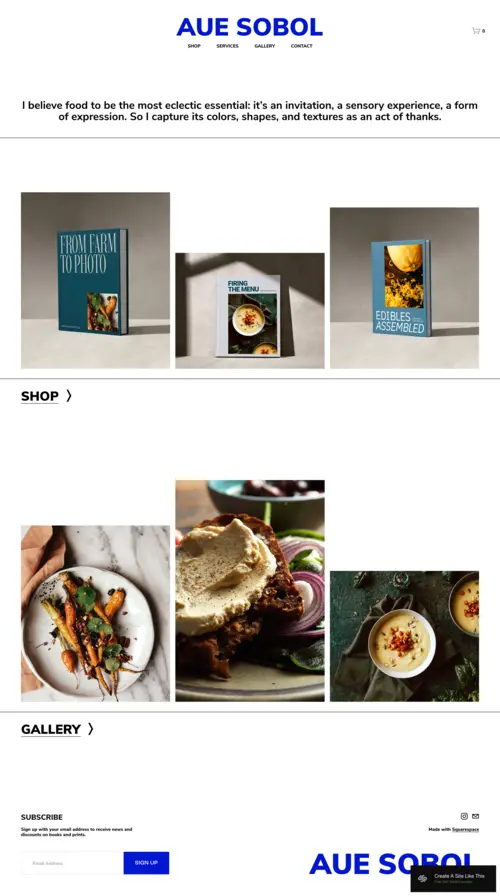
Aue Sobol
Best for Experimental and Avant-Garde Photographers Targeting a Contemporary Art Market ✓ Pros
- Bold, high-impact visual design is calibrated for work that pushes boundaries, avant-garde, experimental, and fashion photography that would look politely contained within a conventional gallery template finds its natural home in Aue Sobol's unapologetically expressive layout.
- Seamless gallery-to-purchase flow guides buyers from engagement with the work to the transaction without a jarring transition between "this is art" and "this is a shop", a friction reduction that matters significantly for buyers who are culturally resistant to the commercial dimension of buying art.
- Contemporary art market aesthetic communicates the kind of institutional credibility that gallery collectors and design professionals associate with work worth investing in, the template's visual sophistication signals that this is serious photographic practice, not casual hobby work sold online.
- Bold image display capabilities allow experimental and fashion photography, with its unusual compositions, unconventional colour palettes, and striking subject matter, to be presented at a scale and with a visual intensity that matches the ambition of the work itself.
- Memorable, distinctive site identity creates a lasting brand impression, buyers who visit multiple photographer websites in the process of considering a print purchase will remember and return to Aue Sobol's distinctive visual experience in a way they won't return to generic gallery templates.
✗ Cons
- The bold, statement-making aesthetic is a highly specific design personality, photographers whose work is quiet, intimate, or naturalistic will find Aue Sobol's dramatic visual character actively conflicts with the tone their images are designed to create.
- The contemporary art market positioning is calibrated for buyers at the more engaged and invested end of the print-buying spectrum, casual décor buyers or first-time print purchasers may find Aue Sobol's intensity creates a barrier rather than an invitation.
- High visual sophistication creates a high standard for the photography itself, work displayed in Aue Sobol's bold framework needs to have the technical and creative quality to meet the expectations the design generates, or the contrast becomes an active liability.
Aue Sobol is the photography print sales template for photographers who understand that making a statement is the prerequisite for making a sale. In a market where buyers choose prints based on an emotional and aesthetic conviction, "this work is doing something I want in my life", Aue Sobol creates the kind of visceral first impression that generates that conviction. For photographers working at the intersection of fine art, fashion, and experimental practice, this is the squarespace photography website for selling prints that matches the ambition of the work it showcases.
How to Choose the Right Squarespace Template to Sell Photography Prints
Match the Template's Aesthetic to Your Buyer's Expectations
The most important alignment in selecting a photography website to sell prints is between the template's visual register and the register of the buyers you're trying to reach. Palmer and Aue Sobol both communicate premium, art-market positioning, but Palmer does it through refinement and quietness, while Aue Sobol does it through bold statement. Balboa and Nevins both serve a broad market effectively, but Balboa's calm structure suits the considered landscape print buyer, while Nevins' dynamic organisation suits the buyer browsing across multiple categories. Fillmore is specifically calibrated for buyers who respond to story as much as image, the travel photography collector, the documentary print buyer, the person who wants to put a piece of a journey on their wall. Before choosing your template, think about who actually buys your prints, where they find you, what they're looking for, and what visual cues tell them they've arrived at the right place.
Optimise for the Gallery-to-Purchase Conversion Journey
Selling prints on Squarespace works best when the gap between "I love this image" and "I've completed my purchase" is as short and intuitive as possible. The conversion journey on a print sales site typically runs: hero impression → gallery browse → specific image engagement → print specification choices (size, paper, edition) → purchase. Each step is an opportunity for friction, unclear sizing options, missing room mockup imagery, complicated checkout processes, or print specification information that requires a separate inquiry. All five templates reviewed here support Squarespace's native e-commerce functionality on any e-commerce plan. The highest-impact conversion optimisation across all five templates is adding room visualisation imagery to individual print product pages: a real interior photo showing the print at scale at your most popular sizes. This single addition consistently produces significant conversion rate improvements for photography print sales sites.
Consider How Your Photography Style Lives in the Template
Not all photography translates equally into all template designs. Landscape and nature photography, with its horizontal formats, consistent colour science, and environmental drama, works best in templates that allow large, unhurried image display: Balboa and Palmer. Diverse portfolio photography across multiple subjects performs best in Nevins' grid-and-collection architecture. Documentary and travel photography benefits from Fillmore's narrative framing that contextualises the subject matter. Experimental and fashion photography finds its natural visual companion in Aue Sobol's bold, contemporary design. Still life, food, and fine art photography matches Palmer's refined, gallery-calibrated aesthetic. Choosing a template that conflicts with the visual character of your photography creates a disconnect that buyers sense without being able to name, and that costs you conversions.
Build Your Print Fulfilment Plan Into Your Platform Choice
A photography website to sell prints is only as effective as the fulfilment experience that follows the purchase. Squarespace integrates natively with print-on-demand services including Printful and Printify, which handle printing, packaging, and shipping automatically with no inventory held by the photographer. For photographers who prefer to control print quality by fulfilling orders themselves (using a specialist fine art printing lab), Squarespace's order management system handles payment, notifications, and customer communication while the photographer processes the fulfilment separately. The template you choose doesn't directly affect your fulfilment model, but your fulfilment model should be fully planned before the site goes live, buyers who place print orders expect clear turnaround times, packaging quality expectations, and return policies, all of which need to be communicated clearly on the product pages and checkout flow of whichever template you select.
Frequently Asked Questions
What is the best Squarespace template for selling photography prints?
How do I set up a print store on Squarespace?
Can I sell limited edition prints through Squarespace?
What print sizes should I offer on my photography website?
Should I use a print-on-demand service or fulfil prints myself?
How do I price my photography prints?
Can I use Squarespace to sell photography prints internationally?
What makes a good photography website to sell prints?
How We Evaluate Templates
Conclusion: Squarespace Photography Website Templates That Turn Browsers Into Print Buyers
The right photography website to sell prints doesn't just showcase your work, it creates the conditions in which buyers feel confident, inspired, and motivated to purchase. Palmer creates that confidence through gallery-calibrated refinement. Balboa creates it through the clean, unhurried space that landscape photography deserves. Nevins creates it through the organised, browsable experience that serves diverse collections and diverse buyers. Fillmore creates it through the narrative immersion that makes buying a print feel like acquiring a piece of a story. Aue Sobol creates it through the bold statement that tells a buyer they've found something worth investing in.
Your photography has already done the hard work of being made. The template you choose is the final decision that determines whether it finds its way onto walls. Choose the design that matches how your buyers think and feel about art, and then make the purchase path as clear and confident as the work itself.
Looking for more creative portfolio inspiration? Start with our roundup of the best Squarespace templates for photographers for a broader overview of photography-focused designs. You can also explore our hand-selected guides for artist portfolio templates, painter website templates, and musician website templates, all reviewed with the same standard: finding designs that give creative work the professional platform it deserves. Filmmakers and videographers should also see our guide to the best Squarespace templates for a video portfolio, which applies the same lens to video-first creative sites.
For more template options in this category, see our guide to Matsuya Squarespace template.
* Read the rest of the post and open up an offer